When it comes to films that blur the lines between reality and the inner psyche, few are as daring or as visually compelling as Altered States (1980). Directed by Ken Russell and based on the novel by Paddy Chayefsky, Altered States offers a psychedelic journey that challenges the very nature of human consciousness. Its screenplay, adapted by Chayefsky himself, is a labyrinthine exploration of science, psychology, and mysticism—a powerful example of how screenwriting can convey hallucinogenic horror on screen. In this article, we’ll delve into the unique elements of Altered States‘ screenplay, exploring how it pushes the boundaries of reality, incorporates layered symbolism, and utilizes sensory experiences to craft an unforgettable cinematic trip.
Setting the Stage: Psychedelia and the Roots of Altered States
The 1970s and 1980s marked a golden age of experimental cinema, with filmmakers pushing visual and thematic boundaries to explore the human mind and the countercultural allure of psychedelics. Altered States emerged from this cultural zeitgeist, pulling from both scientific experimentation and the mystical experiences associated with psychedelics. At the film’s core is Dr. Eddie Jessup, a Harvard scientist obsessed with the idea of transcending human consciousness through mind-altering substances and sensory deprivation. His goal is not merely to understand altered states of mind but to regress, shedding layers of human evolution to find an ancient, primal self.
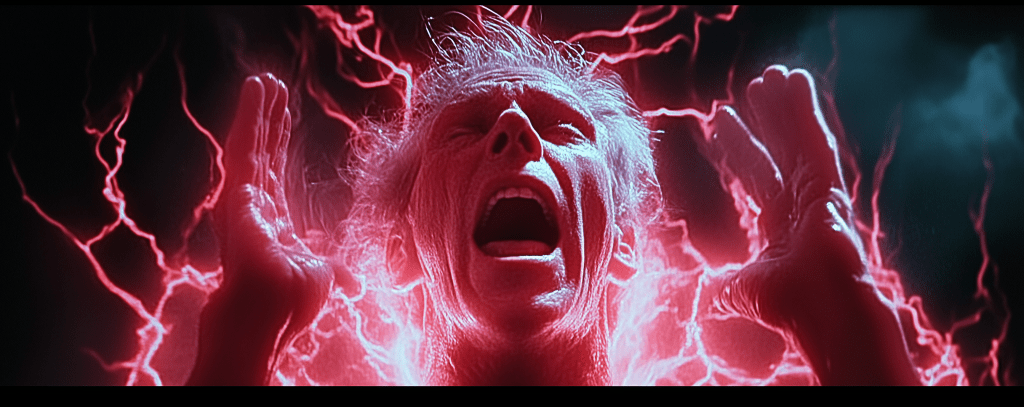
The screenplay, largely faithful to Chayefsky’s novel, taps into a fascination with inner transformation, a quest for meaning that is as terrifying as it is seductive. The film’s premise takes the psychedelic experience, which typically involves deep introspection and the dissolution of ego, and ramps it up to nightmarish heights. Here, the screenplay succeeds in creating a hallucinogenic horror story—one that is both deeply cerebral and viscerally terrifying.
Building Tension through Transformation
One of the most fascinating aspects of the Altered States screenplay is its approach to physical and mental transformation. Chayefsky’s script is relentless in depicting Eddie’s descent, not merely as a metaphor but as a literal regression. Screenwriters and novelists who tackle transformations usually focus on emotional or intellectual changes, yet Altered States amplifies this trope by manifesting Eddie’s inner journey through horrifying physical shifts.
From a screenwriting perspective, these transformations serve multiple purposes. First, they drive the story’s tension, as Eddie’s experiments grow increasingly dangerous. As his body begins to morph in response to his altered states, the horror becomes tangible, linking mind and body inextricably. The screenplay uses these transformations as a physical embodiment of psychological horror, bridging the internal and external worlds in a way that is rare and unsettling. This transformation-based horror has been a thematic element in films like The Fly (1986) and Black Swan (2010), but Altered States takes it a step further by treating consciousness as a vehicle of metamorphosis.
In screenwriting terms, this is achieved through a careful layering of Eddie’s transformations, each one pushing further into the unknown. The gradual build, with each experiment diving deeper and becoming more perilous, is crucial. This progression mirrors a three-act structure where each act escalates the stakes, with Eddie’s obsession pushing him to near-destruction by the final climax.
The Language of Psychedelic Visuals and Sensory Detachment
One of Altered States’ most distinctive screenwriting elements is its visual language, specifically tailored to communicate the psychedelic experiences Eddie undergoes. While scripts are often thought of as word-based blueprints, in Altered States, Chayefsky’s writing places emphasis on sensory cues that transcend traditional dialogue or action. This is evident in the way the script describes Eddie’s hallucinations—visions that are both vividly detailed and intentionally disorienting.
For instance, instead of simply writing “Eddie hallucinates,” the screenplay provides sensory-based descriptions like “a swirl of molten colors” or “a desert storm inside the eye of a deity.” These choices enhance the surrealism, creating a layered sensory experience that invites the director and visual artists to experiment with disturbing, otherworldly imagery. The effect is cinematic yet deeply script-driven, as the screenplay gives clear cues that guide the creation of visuals meant to unnerve and overwhelm.
This approach has become a hallmark of psychological and horror films dealing with altered states, as seen in Darren Aronofsky’s Requiem for a Dream (2000) and Black Swan (2010). In these films, sensory overload or deprivation becomes a storytelling technique that conveys character descent or transformation. By embedding visual horror within the screenplay itself, Altered States creates a sensory language that builds an immersive world, one in which viewers feel the disorientation and dread of Eddie’s experience.
Characterization through Obsession and Isolation
In Altered States, Eddie Jessup’s character is the classic obsessive scientist trope turned up to eleven, embodying both a seeker of truth and a tragic hero lost in his quest. However, the screenplay diverges from the stereotypical “mad scientist” by giving Eddie a multidimensional, almost philosophical drive. His pursuit of self-discovery reflects not just a hunger for knowledge, but an insatiable desire to unravel the very fabric of reality. This is an essential aspect of the script that gives Eddie’s journey a tragic depth.
What’s particularly compelling from a screenwriting perspective is how Eddie’s character arc reflects an internal conflict between scientific detachment and personal obsession. He isolates himself from his family, colleagues, and even his own sense of self. The screenplay uses dialogue sparingly, relying instead on Eddie’s actions, his intensity, and his detachment from reality to convey his decline. For example, early scenes depict Eddie as intellectually curious yet dismissive of emotional connections; by the film’s climax, he has alienated himself completely, becoming an “altered state” both physically and emotionally.
The isolation aspect resonates with screenwriting in the horror genre, where isolation can often be a vehicle for psychological horror. Films like The Shining (1980) and Hereditary (2018) utilize characters’ withdrawal from loved ones to emphasize their descent into madness. Altered States employs this device effectively, using Eddie’s psychological isolation as a manifestation of his inner conflict, which culminates in a hauntingly lonely and ambiguous resolution.
Symbolism and the Spiritual Abyss
Altered States is rich with symbolism that enhances its psychedelic narrative. Chayefsky’s screenplay incorporates religious and mythological motifs, with Eddie’s journey serving as both a scientific exploration and a quasi-spiritual quest. This dual approach elevates the script beyond simple horror; Eddie’s regression taps into primal and universal fears. By exploring themes of God, human origins, and the boundaries of consciousness, the screenplay connects Eddie’s journey to broader, archetypal questions that resonate deeply with viewers.
For instance, Eddie’s hallucinations often depict biblical and primordial imagery—flames, deserts, and figures of ancient gods—each scene adding a layer to the idea of man’s insignificance in the face of the universe. From a screenwriting perspective, this use of symbolism allows the film to engage in abstract philosophical themes without relying heavily on expository dialogue. Instead, the horror of Eddie’s experiences speaks for itself, using symbols to communicate ideas that transcend language. In many ways, Altered States resembles films like Apocalypse Now (1979), where visuals and symbolic sequences speak to a character’s internal struggle and spiritual dissolution.
Screenwriters looking to imbue their work with deeper layers can take inspiration from Chayefsky’s symbolic approach. By weaving visual and thematic symbols into the screenplay, writers can craft a narrative that feels intellectually and emotionally complex, rewarding viewers who look beyond surface-level horror.
Exploring the Hallucinogenic: Writing and Portraying the “Unreliable Reality”
In Altered States, reality itself becomes an unreliable element. Eddie’s perceptions, increasingly warped by his experiments, challenge both the character and the audience to question what is real. This is a crucial technique for any screenplay that aims to explore psychedelia or altered states of mind. The script frequently destabilizes the viewer’s grasp on reality, employing disjointed scenes, dream logic, and hallucinatory visuals to mirror Eddie’s psychological descent.
For screenwriters, portraying an “unreliable reality” requires careful calibration between showing and disorienting. Too little ambiguity, and the hallucinogenic quality is lost; too much, and the plot risks becoming incoherent. Altered States finds this balance by rooting Eddie’s experiences in recognizable yet twisted versions of reality. Each altered state is grounded in his desire for truth, making even the most outlandish scenes feel anchored in character motivation. The film’s screenplay echoes other works that employ unreliable reality, such as Inception (2010), where the disintegration of layers of consciousness is crucial to the story’s structure.
Final Thoughts: Lessons from Altered States for Screenwriters
Altered States is an exemplar of hallucinogenic horror, a genre that uses surrealism and psychological depth to unsettle and provoke. Chayefsky’s screenplay demonstrates how scriptwriting can effectively portray altered states of consciousness, blending horror with philosophical inquiry. For screenwriters, the film offers several valuable lessons:
- Use Transformation as Tension: Character transformations, both psychological and physical, can serve as horror elements. Build tension by gradually increasing the stakes with each transformation, leading the audience deeper into the character’s experience.
- Prioritize Sensory Descriptions: Particularly in scripts exploring altered states, sensory language is essential. Describe colors, sounds, and textures to give directors and artists a canvas for immersive, psychedelic visuals.
- Embrace Symbolism: Use religious mythological, or natural symbols to convey complex ideas and emotions that transcend simple dialogue. These can enrich a screenplay, adding layers for viewers to unravel.
- Balance the Unreliable Reality: For stories that question reality, a balance is crucial. Ground hallucinogenic or dream-like sequences in character motivations to maintain coherence while still disorienting the viewer.
- Characterization through Obsession: Obsession can be a powerful driving force in horror, and isolating the character can heighten this effect. Use their fixation as a narrative tool to create both horror and sympathy.
In Altered States, we see the potential of screenwriting as a medium to explore the farthest reaches of human consciousness and horror. For writers and filmmakers interested in psychedelic or psychological horror, it serves as both inspiration and a masterclass in depicting the limits of reality, transformation, and the terrifying depths of the human psyche.
✍️ Whether you’re mastering the art of dialogue, structure, or character development, the power of AI can be a game-changer in your writing journey. My Free Ebook, ‘AI for Authors’ delves into how AI-powered prompts can provide a unique edge to your storytelling process. If you’re intrigued by the prospect of supercharging your fiction skills, download your free copy today and explore new horizons in creative writing.
 A.I. in Screen Trade