In the realm of screenwriting, few films capture the intricacies of family dynamics and societal upheaval as masterfully as Ang Lee’s 1997 drama, “The Ice Storm.” Based on Rick Moody’s novel and adapted for the screen by James Schamus, this film serves as a prime example of how skilled screenwriting can bring complex characters and themes to life. In this article, we’ll delve into the screenwriting techniques employed in “The Ice Storm” to portray family dysfunction, exploring how the film’s structure, dialogue, and character development contribute to its powerful narrative.
Setting the Scene: 1970s Suburban Malaise
One of the first challenges faced by Schamus in adapting “The Ice Storm” was establishing the film’s setting and atmosphere. The story takes place in New Canaan, Connecticut, during Thanksgiving weekend of 1973. This era, marked by political scandal, sexual liberation, and shifting social norms, provides a rich backdrop for the film’s exploration of family dysfunction.
Schamus masterfully weaves historical context into the screenplay without resorting to heavy-handed exposition. Instead, he allows the setting to emerge organically through character interactions, visual cues, and subtle references. For instance, the film opens with Paul Hood’s voiceover narration as he reads from a Fantastic Four comic book, immediately situating us in the early 1970s while also introducing themes of isolation and disconnection that will permeate the story.
Screenwriting Tip: When establishing a historical setting, look for opportunities to integrate period-specific details naturally into your characters’ lives and dialogue. This approach is more engaging than relying on expository narration or text overlays.
Character Development: The Fracturing Family Unit
At the heart of “The Ice Storm” are two interconnected families: the Hoods and the Carvers. Schamus’s screenplay excels in developing these characters, each grappling with their own form of discontent and searching for meaning in a rapidly changing world.
The Hood Family
- Ben Hood: The patriarch, struggling with his own desires and inability to connect with his family.
- Elena Hood: The matriarch, feeling unfulfilled and exploring her own sexuality.
- Paul Hood: The teenage son, navigating his first romantic experiences while away at boarding school.
- Wendy Hood: The precocious daughter, experimenting with her sexuality and pushing boundaries.
The Carver Family
- Jim Carver: The absent father, whose work takes him away from home frequently.
- Janey Carver: The bored housewife, engaging in an affair with Ben Hood.
- Mikey Carver: The introspective teenage son, questioning societal norms and his place in the world.
- Sandy Carver: The younger son, curious about sexuality and often following his brother’s lead.
Schamus’s screenplay gives each character depth and complexity, avoiding stereotypes and easy categorizations. This is achieved through a combination of revealing dialogue, subtle actions, and moments of introspection.
Screenwriting Tip: When developing characters in a family drama, ensure that each member has their own distinct arc and internal struggles. This adds depth to the overall family dynamic and creates opportunities for conflict and growth.
Dialogue: Revealing Character Through Subtext
One of the strengths of “The Ice Storm” screenplay lies in its nuanced dialogue. Schamus crafts conversations that reveal character and advance the plot while maintaining a sense of naturalism. The characters often talk around their true feelings, with subtext playing a crucial role in conveying emotion and tension.
Consider this exchange between Ben and Elena Hood:
BEN: How was your day?
ELENA: Oh, you know. The usual.
BEN: (pause) Janey Carver called. She's having a "gathering."
ELENA: (coolly) Is she?
BEN: I thought we might go.
ELENA: Why not? We wouldn't want to miss out on all the fun.
This seemingly mundane conversation is loaded with unspoken tension. Elena’s curt responses and the mention of Janey Carver (with whom Ben is having an affair) create an undercurrent of hostility and resentment.
Screenwriting Tip: Use subtext in dialogue to convey complex emotions and relationships. Allow characters to talk around their true feelings, creating tension and inviting the audience to read between the lines.
Structure: The Gathering Storm
“The Ice Storm” employs a non-linear structure, with events unfolding over the course of the Thanksgiving weekend, punctuated by flashbacks and parallel storylines. This approach allows Schamus to build tension gradually, with each scene revealing new layers of dysfunction within and between the two families.
The screenplay is structured around several key events:
- Paul’s experiences at boarding school
- The “key party” at the Carvers’ house
- Wendy’s sexual experimentation with the Carver boys
- The titular ice storm that brings events to a climax
This structure allows for a slow burn, with tensions mounting until they reach a breaking point during the ice storm. The natural disaster serves as both a literal and metaphorical catalyst, forcing characters to confront their actions and relationships.
Screenwriting Tip: Consider using non-linear structures and parallel storylines to build tension and create thematic resonance between different character arcs. Look for ways to use external events (like the ice storm) as metaphors for internal conflicts.
Themes: Alienation and Connection in the Modern World
Throughout the screenplay, Schamus explores themes of alienation, disconnection, and the search for meaning in a rapidly changing society. These themes are reflected in various ways:
Technology and Disconnection
The screenplay incorporates references to technology of the era, such as the Watergate hearings on television and Paul’s fascination with comics. These elements serve to highlight the characters’ disconnection from one another and from their own emotions.
Sexual Exploration and Emptiness
Both the adults and teenagers in the film engage in sexual experimentation, but these encounters often leave them feeling more isolated than fulfilled. The “key party” scene, in particular, serves as a potent symbol of the emptiness underlying the characters’ pursuit of pleasure.
Nature vs. Civilization
The encroachment of the ice storm on the carefully manicured suburban landscape serves as a metaphor for the breakdown of social norms and family structures. The storm forces characters to confront the fragility of their lives and relationships.
Screenwriting Tip: Develop strong thematic threads that run throughout your screenplay. Use symbolism, recurring motifs, and parallel storylines to reinforce these themes and add depth to your narrative.
Visual Storytelling: Translating Words to Images
While a screenplay is primarily a written document, it’s crucial for screenwriters to think visually. Schamus’s script for “The Ice Storm” demonstrates a keen awareness of how words on the page will translate to images on screen.
Consider this description from the screenplay:
EXT. SUBURBAN STREET - NIGHT

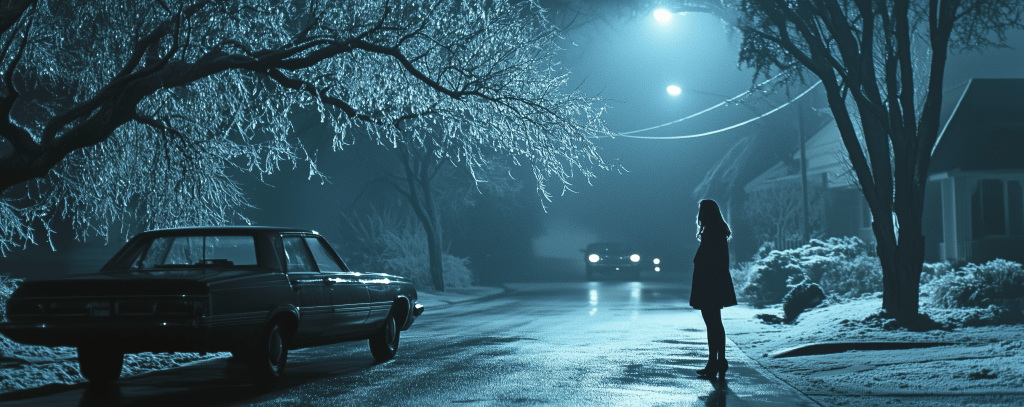
The ice-covered trees glisten in the moonlight. Branches CREAK under the weight of the ice. In the distance, we hear the SNAP of a branch breaking.

Wendy walks alone down the middle of the street, her breath visible in the frigid air. She looks small and vulnerable against the looming trees.
This passage not only sets the scene but also conveys mood and character. The description of the ice-covered trees and breaking branches creates a sense of tension and impending danger, while Wendy’s solitary figure emphasizes her vulnerability and isolation.
Screenwriting Tip: When writing scene descriptions, focus on details that convey mood and theme as well as physical setting. Think about how your words can be translated into striking visual images that enhance the story’s emotional impact.
Conclusion: Crafting Complex Family Narratives
“The Ice Storm” stands as a masterclass in screenwriting, particularly in its portrayal of family dysfunction. Through careful character development, nuanced dialogue, thematic depth, and a keen sense of visual storytelling, James Schamus created a screenplay that captures the complexities of human relationships and the turbulent spirit of an era.
For screenwriters looking to craft their own family dramas or complex character studies, “The Ice Storm” offers valuable lessons:
- Develop rich, multifaceted characters with their own internal struggles and arcs.
- Use dialogue and subtext to reveal character and build tension.
- Employ non-linear structures and parallel storylines to create thematic resonance.
- Integrate historical and cultural context organically into the narrative.
- Think visually, using descriptive language that translates well to the screen.
- Explore universal themes through specific, well-realized characters and situations.
By studying and applying these techniques, screenwriters can create narratives that resonate deeply with audiences, offering insights into the human condition and the complex dynamics that shape our most intimate relationships.
✍️ Whether you’re mastering the art of dialogue, structure, or character development, the power of AI can be a game-changer in your writing journey. My Free Ebook, ‘AI for Authors’ delves into how AI-powered prompts can provide a unique edge to your storytelling process. If you’re intrigued by the prospect of supercharging your fiction skills, download your free copy today and explore new horizons in creative writing.
 A.I. in Screen Trade