Introduction
Released in 1988, “Heathers” stands as a cult classic that redefined the teen movie genre with its pitch-black humor and biting social commentary. Written by Daniel Waters and directed by Michael Lehmann, this dark comedy masterpiece continues to captivate audiences decades after its initial release. In this analysis, we’ll delve into the screenwriting techniques that make “Heathers” a standout example of dark comedy, exploring how its clever dialogue, complex characters, and subversive plot elements come together to create a film that’s both hilarious and deeply unsettling.
Setting the Stage: The World of Westerburg High
A Twisted Take on the Teen Movie Formula
“Heathers” begins by presenting a familiar high school hierarchy, but quickly subverts expectations. The popular clique, led by three girls all named Heather, rules the school with an iron fist. Our protagonist, Veronica Sawyer (Winona Ryder), is part of this group but struggles with her role in it. This setup allows Waters to play with and ultimately deconstruct the tropes of typical teen movies.
Establishing Tone Through Dialogue
From the opening scenes, the film’s dialogue sets it apart. The characters speak in a heightened, almost theatrical manner, peppered with unique slang that gives the film its distinct voice. Lines like “What’s your damage, Heather?” and “How very” immediately signal to the audience that this is not your average teen comedy.
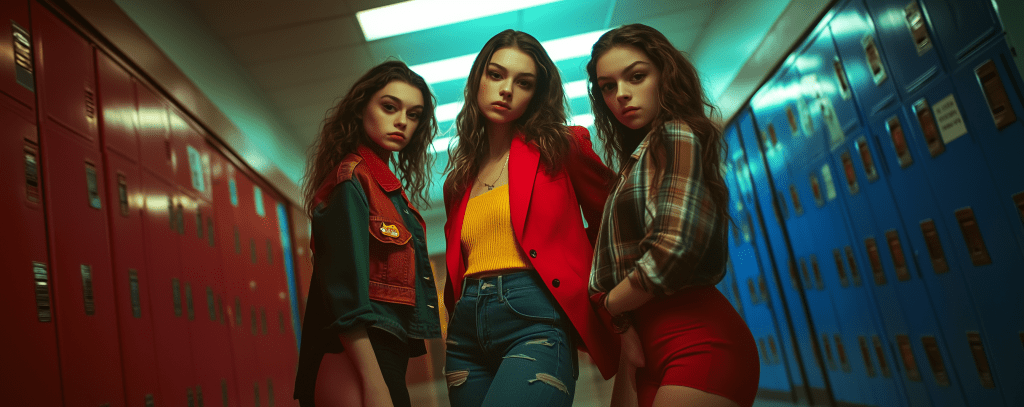
The screenwriting technique of creating a specific linguistic world helps to both ground the film in its setting and contribute to its surreal, darkly comic tone. This stylized dialogue serves multiple purposes:
- It creates a sense of alienation, mirroring the characters’ disconnect from reality.
- It adds to the humor through its absurdity and cleverness.
- It allows for sharp social commentary to be delivered in a palatable, entertaining way.
Character Development: Antiheroes and Antagonists
Veronica Sawyer: The Conflicted Protagonist
At the center of “Heathers” is Veronica Sawyer, a character who defies easy categorization. Waters crafts Veronica as an antihero, someone who participates in cruel behavior while simultaneously critiquing it. This complexity is key to the film’s dark comedy:
- It allows the audience to relate to Veronica’s struggles while also being shocked by her actions.
- It creates tension between Veronica’s desire to fit in and her moral compass.
- It sets up her character arc, which drives the plot forward in increasingly outrageous ways.
J.D.: The Charismatic Villain
The introduction of Jason “J.D.” Dean (Christian Slater) kicks the dark comedy into high gear. J.D. is written as a charismatic outsider who seduces Veronica with his rebellious attitude and seeming depth. Waters uses J.D. to explore themes of teen alienation and rage, but does so through a lens of pitch-black humor.
The screenwriting brilliance in J.D.’s character lies in how Waters balances his appeal with his psychopathy:
- His witty dialogue and cool demeanor make him initially attractive to both Veronica and the audience.
- His escalating violent tendencies are presented with a mix of horror and absurd comedy.
- The contrast between J.D.’s articulate philosophy and his unhinged actions creates a cognitive dissonance that fuels the dark humor.
The Heathers: Archetypes Turned on Their Head
The three Heathers (Heather Chandler, Heather Duke, and Heather McNamara) represent different aspects of the popular clique archetype. Waters takes these familiar teen movie characters and pushes them to extremes:
- Heather Chandler, the “mythic bitch,” is so cartoonishly cruel that her eventual demise feels both shocking and darkly satisfying.
- Heather Duke’s transformation from submissive follower to power-hungry leader satirizes the cyclical nature of high school politics.
- Heather McNamara’s vulnerability adds a layer of complexity to the group dynamic, showing the toll of maintaining a perfect facade.
By exaggerating these characters’ traits, Waters creates a satirical take on high school social structures that’s both funny and uncomfortably true.
Plot Structure: Escalation and Absurdity
The Snowball Effect of Violence
One of the most striking aspects of “Heathers” is how it escalates its dark premise. What begins as an accidental poisoning quickly spirals into a series of staged suicides and attempted mass murder. This escalation serves several purposes in the screenplay:
- It keeps the audience off-balance, never quite sure how far the film will go.
- It allows for increasingly absurd situations, pushing the boundaries of dark comedy.
- It raises the stakes for Veronica, forcing her to confront the consequences of her actions.
The screenwriting technique of continuous escalation maintains tension while also ramping up the satirical elements of the story.
Subverting Expectations
Waters consistently subverts audience expectations throughout the script. This is evident in several key plot points:
- The popular girl doesn’t reform the bad boy; instead, she gets pulled into his violent world.
- The accidental death of Heather Chandler doesn’t lead to guilt and confession, but to more elaborate deceptions.
- The film’s climax involves stopping a school bombing, a plot element that was shocking for its time and remains disturbingly relevant.
By continually defying conventional narrative expectations, “Heathers” keeps its audience engaged and uncomfortable, a hallmark of effective dark comedy.
Themes and Social Commentary
The Brutality of High School Social Dynamics
At its core, “Heathers” is a biting satire of high school social structures. Waters uses dark comedy to explore:
- The cruelty of popular cliques and the pressure to conform
- The superficiality of teen relationships and reputations
- The adults’ obliviousness to the real issues facing students
By exaggerating these elements to absurd degrees, the screenplay highlights the very real pain and struggle of the teen experience.
Media Sensationalism and Public Reaction
As the deaths in the film mount, Waters introduces a brilliant satirical element: the public’s reaction to the perceived suicide epidemic. This allows the screenplay to comment on:
- The media’s tendency to sensationalize tragedy
- Society’s superficial understanding of teen issues
- The hypocrisy of adults who suddenly care about problems they previously ignored
This aspect of the script feels particularly prescient, anticipating the media frenzies that would surround real-life school tragedies in the years to come.
The Emptiness of Rebellion
Through J.D.’s character, “Heathers” explores the idea of rebellion and its ultimate futility. The screenplay presents J.D.’s violent actions as a form of misguided revolution against society, only to reveal the emptiness behind his philosophy. This theme is handled with dark humor that:
- Mocks the self-seriousness of teen rebellion
- Highlights the absurdity of trying to change society through destruction
- Shows the danger of charismatic figures who preach easy solutions to complex problems
Cinematic Elements in the Screenplay
Visual Gags and Set Pieces
While a screenplay is primarily about dialogue and action, Waters includes numerous visual elements that contribute to the film’s dark comedy:
- The use of croquet as a visual metaphor for social dynamics
- The exaggerated, color-coded costumes of the Heathers
- The increasingly elaborate suicide notes and death scenes
These visual elements, when described in the screenplay, help to create a cohesive aesthetic that enhances the film’s satirical tone.
Dream Sequences and Fantasies
Waters incorporates several dream sequences and fantasies into the screenplay, which serve to:
- Illustrate Veronica’s inner conflicts
- Provide moments of surreal comedy
- Foreshadow future events in a stylized manner
These sequences add another layer of dark humor to the film, allowing for even more outrageous scenarios than the main plot permits.
The Legacy of “Heathers” in Screenwriting
Influence on Future Dark Comedies
The success of “Heathers” paved the way for other dark teen comedies and satirical looks at high school life. Its influence can be seen in films and TV shows like:
- “Mean Girls” (2004)
- “Jawbreaker” (1999)
- “Buffy the Vampire Slayer” (TV series, 1997-2003)
These works owe a debt to “Heathers” for showing how dark subject matter could be successfully married with comedy in a teen setting.
Tackling Taboo Subjects
Perhaps the most significant legacy of “Heathers” is its willingness to tackle taboo subjects head-on. The screenplay doesn’t shy away from issues like:
- Teen suicide
- School violence
- Eating disorders
- Sexual coercion
By addressing these topics through the lens of dark comedy, “Heathers” opened up new possibilities for how difficult subjects could be approached in film.
Conclusion
“Heathers” remains a masterclass in dark comedy screenwriting. Through its clever dialogue, complex characters, and willingness to push boundaries, the film creates a satirical world that is both hilarious and deeply unsettling. Daniel Waters’ screenplay demonstrates the power of using comedy to explore serious themes, proving that laughter can be a potent tool for social commentary.
The enduring legacy of “Heathers” lies in its perfect balance of humor and horror, its quotable lines, and its unflinching look at the darker aspects of the teen experience. As a piece of screenwriting, it stands as a testament to the power of a unique voice and a willingness to take risks. In the world of dark comedy, “Heathers” truly is “very.”
✍️ Whether you’re mastering the art of dialogue, structure, or character development, the power of AI can be a game-changer in your writing journey. My Free Ebook, ‘AI for Authors’ delves into how AI-powered prompts can provide a unique edge to your storytelling process. If you’re intrigued by the prospect of supercharging your fiction skills, download your free copy today and explore new horizons in creative writing.
 A.I. in Screen Trade