Introduction to Realistic Dialogue
Overview of Realistic Dialogue
Realistic dialogue is the lifeblood of compelling screenwriting. It’s the tool through which characters come to life, their personalities, backgrounds, and motivations revealed through the words they choose and the way they speak. Authentic dialogue mimics real-life conversations, providing a sense of immediacy and believability that draws audiences into the story. Achieving this authenticity, however, is no small feat. Writers must navigate the delicate balance between naturalism and narrative needs, ensuring dialogue is engaging without feeling contrived or overly expository.
In screenwriting, realistic dialogue serves several critical functions. It advances the plot, develops characters, establishes relationships, and creates the film’s tone and atmosphere. Unlike real conversations, which can be meandering and filled with trivialities, cinematic dialogue must be purposeful and precise, delivering information efficiently while maintaining a sense of spontaneity. This requirement presents a significant challenge: writing dialogue that feels both true to life and dramatically effective.
Tarantino’s Signature Style
Quentin Tarantino stands as a master of dialogue in modern cinema. His scripts are renowned for their witty, rapid-fire exchanges that blend humor, tension, and cultural references into a seamless flow. Tarantino’s dialogue often defies the conventions of traditional screenwriting, opting instead for extended conversations that reveal character depth and build narrative momentum in unexpected ways.
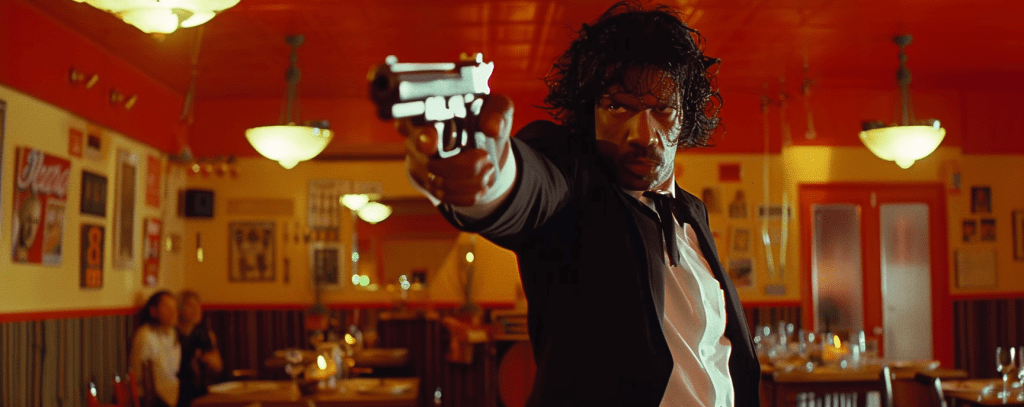
Tarantino’s signature style is characterized by its rhythmic cadence and the juxtaposition of the mundane with the profound. His characters frequently engage in seemingly trivial discussions that, upon closer inspection, serve to enhance the narrative and deepen the audience’s understanding of the characters. This approach allows Tarantino to inject realism into his films, capturing the ebb and flow of real conversations while ensuring that every word serves a purpose.
Setting the Scene: ‘Pulp Fiction’
Released in 1994, ‘Pulp Fiction’ is widely regarded as one of Tarantino’s masterpieces and a seminal work in independent cinema. The film’s non-linear narrative, eclectic ensemble cast, and groundbreaking dialogue have cemented its status as a cultural touchstone. ‘Pulp Fiction’ weaves together multiple interconnected stories, each featuring characters whose lives intersect in unexpected and often violent ways.
At the heart of ‘Pulp Fiction’ is its dialogue, which drives the narrative forward and provides insight into the complex, often contradictory natures of its characters. From hitmen discussing fast food to a boxer negotiating his escape, the film’s dialogue is both rich in subtext and replete with memorable lines that have become ingrained in popular culture. Tarantino’s ability to craft dialogue that is simultaneously entertaining and revealing is a testament to his skill as a writer and his deep understanding of human interaction.
The characters in ‘Pulp Fiction’ are vividly brought to life through their distinctive voices and the way they communicate with one another. Each character’s dialogue is meticulously tailored to reflect their unique background, personality, and motivations. For instance, Jules Winnfield (Samuel L. Jackson) uses eloquent, almost philosophical language, contrasting sharply with his violent profession, while Vincent Vega (John Travolta) employs a more casual, laid-back vernacular. This attention to detail ensures that every line of dialogue feels authentic to the character speaking it.
One of the key features of Tarantino’s dialogue in ‘Pulp Fiction’ is its ability to blend humor with tension, creating scenes that are as unpredictable as they are engaging. The film’s opening scene, set in a diner, exemplifies this approach. A seemingly innocuous conversation between a couple, Honey Bunny (Amanda Plummer) and Pumpkin (Tim Roth), quickly escalates into a tense standoff, setting the tone for the rest of the film. This scene, like many others in ‘Pulp Fiction,’ showcases Tarantino’s talent for crafting dialogue that keeps audiences on the edge of their seats while simultaneously providing critical character and plot information.
Another hallmark of Tarantino’s dialogue is his use of cultural references and pop culture trivia, which serve to ground his characters in a recognizable reality while also adding layers of meaning to their interactions. In ‘Pulp Fiction,’ characters often engage in discussions about movies, music, and other aspects of popular culture, lending an air of authenticity to their conversations. This technique not only makes the dialogue feel more natural but also allows Tarantino to explore broader themes and social commentary through the lens of his characters’ everyday interactions.
Tarantino’s dialogue in ‘Pulp Fiction’ is also notable for its subtext and the way it reveals information indirectly. Characters often speak in coded language or use metaphor and analogy to convey their true intentions and emotions. This layered approach to dialogue adds depth to the film, encouraging audiences to read between the lines and engage more actively with the story. For example, in the famous “Royale with Cheese” scene, the seemingly trivial conversation about fast food in Europe serves as a vehicle for exploring the characters’ personalities and establishing their rapport.
Analysis of Key Dialogue Scenes in ‘Pulp Fiction’
The Opening Scene: Honey Bunny and Pumpkin
‘Pulp Fiction’ begins with a deceptively simple conversation in a diner between a couple, Honey Bunny (Amanda Plummer) and Pumpkin (Tim Roth). This scene is a masterclass in dialogue-driven storytelling, setting the stage for the film’s tone and introducing key thematic elements.
The conversation starts with Pumpkin lamenting the dangers and diminishing returns of robbing liquor stores. This seemingly mundane topic quickly transitions into a spontaneous decision to rob the diner they are sitting in. Tarantino uses this dialogue to immediately establish the characters’ relationship and personalities. Honey Bunny’s transformation from affectionate partner to aggressive accomplice is marked by her sudden switch in demeanor, illustrated through her dialogue: “Any of you fucking pricks move, and I’ll execute every motherfucking last one of you!”
This dialogue serves multiple purposes. It introduces the audience to Tarantino’s signature style of blending casual conversation with sudden violence, creating an unsettling yet intriguing dynamic. The scene also sets up the film’s non-linear narrative structure, as this couple reappears later in the story, tying different plot threads together. Through their dialogue, we learn about the impulsiveness and volatility of these characters, setting the stage for the unpredictability that characterizes the rest of the film.
The Iconic “Royale with Cheese” Scene
One of the most memorable scenes in ‘Pulp Fiction’ is the “Royale with Cheese” conversation between Vincent Vega (John Travolta) and Jules Winnfield (Samuel L. Jackson). This scene epitomizes Tarantino’s talent for turning mundane topics into compelling dialogue that reveals character and context.
The conversation takes place as Vincent and Jules drive to an assignment. They discuss the differences between American and European fast food, focusing on the fact that in France, a Quarter Pounder with Cheese is called a “Royale with Cheese.” This seemingly trivial discussion does more than provide comic relief; it serves to humanize the characters, showing them as ordinary people with everyday interests despite their violent profession.
This scene also subtly builds the world of ‘Pulp Fiction.’ Through their dialogue, we get a sense of the characters’ experiences and personalities. Vincent’s enthusiasm for sharing his knowledge about Europe reveals his love for travel and curiosity about different cultures, while Jules’ responses showcase his wit and grounded nature. The casual, yet engaging dialogue makes the characters relatable and endears them to the audience, enhancing the impact of their actions later in the film.
Moreover, this scene highlights Tarantino’s skill in using dialogue to set a relaxed, conversational tone that contrasts sharply with the violent events that follow. This juxtaposition keeps the audience engaged and on edge, as the casual banter lulls them into a false sense of security before the narrative takes a darker turn.
The “Ezekiel 25:17” Monologue
Another standout moment in ‘Pulp Fiction’ is Jules Winnfield’s “Ezekiel 25:17” monologue. Delivered with intense conviction, this speech is both a narrative anchor and a character-defining moment. Jules recites the passage before executing his victims, using it to justify his actions and assert his moral authority.
The monologue serves multiple functions. On a surface level, it adds to the menacing persona of Jules, making him a formidable and memorable character. However, its deeper significance lies in its role as a turning point in Jules’ character arc. By the end of the film, Jules reinterprets the passage as a reflection on his own life, seeing himself not as the righteous man but as the tyranny of evil men. This realization leads to his decision to leave his life of crime, illustrating his internal struggle and growth.
Tarantino’s use of this monologue also showcases his ability to blend humor, tension, and philosophical inquiry. The initial delivery of the speech is both terrifying and oddly humorous, given Jules’ dramatic flair and the absurdity of quoting scripture before a murder. As the film progresses, the speech takes on a more profound meaning, reflecting themes of redemption and moral ambiguity.
The dialogue in this scene exemplifies how Tarantino uses language to explore complex themes while keeping the audience captivated. Jules’ transformation, underscored by his evolving interpretation of the monologue, adds depth to his character and highlights the film’s exploration of morality and change.
Techniques for Crafting Realistic Dialogue
Character Voice and Consistency
One of the most critical aspects of writing realistic dialogue is ensuring that each character has a unique and consistent voice. This involves crafting dialogue that reflects their background, personality, and motivations. In ‘Pulp Fiction,’ Quentin Tarantino excels at creating distinctive voices for his characters, making each conversation memorable and true to the individual speaking.
For example, Jules Winnfield (Samuel L. Jackson) speaks with a blend of street-smart wisdom and philosophical depth, often quoting biblical passages with dramatic flair. His partner, Vincent Vega (John Travolta), has a more laid-back, casual style, reflecting his easygoing nature and experience as a seasoned hitman. This contrast is evident in their conversations, where Jules’ intensity plays off Vincent’s relaxed demeanor, creating dynamic and engaging exchanges.
Tarantino’s commitment to character voice and consistency helps to build a believable world where each character feels real and fully realized. This technique ensures that dialogue not only advances the plot but also deepens the audience’s understanding of each character. Writers can learn from this approach by developing detailed character profiles and staying true to these profiles when writing dialogue, ensuring that each character’s speech patterns and word choices align with their personality and background.
Subtext and Implication
Subtext—the underlying meaning behind the spoken words—is a powerful tool in crafting realistic dialogue. It allows characters to convey deeper emotions and intentions without explicitly stating them, adding complexity and depth to their interactions. Tarantino is a master of subtext, using it to enrich his dialogue and engage the audience on multiple levels.
In ‘Pulp Fiction,’ the “Royale with Cheese” conversation between Vincent and Jules is a prime example of subtext at work. While the surface topic is a trivial discussion about fast food in Europe, the underlying subtext reveals much about their relationship and worldviews. This seemingly casual conversation establishes their camaraderie and highlights their differing perspectives, with Vincent’s curiosity and Jules’ grounded pragmatism coming to the fore.
Tarantino also uses subtext to create tension and foreshadow future events. In the scene where Mia Wallace (Uma Thurman) and Vincent dine at Jack Rabbit Slim’s, their flirtatious banter is laden with unspoken implications and sexual tension. This subtext adds a layer of complexity to their interaction, making the dialogue more engaging and suspenseful.
For writers, mastering subtext involves thinking about what the characters are really trying to communicate beneath their words. This requires a deep understanding of the characters’ motivations and relationships, as well as careful attention to the context in which the dialogue takes place. By incorporating subtext, writers can create dialogue that resonates on multiple levels, drawing the audience deeper into the story.
Pacing and Rhythm in Conversation
The pacing and rhythm of dialogue are crucial for maintaining the flow and realism of conversations. Natural dialogue has a rhythm that can be fast-paced and energetic or slow and deliberate, depending on the situation and the characters involved. Tarantino’s dialogues in ‘Pulp Fiction’ exemplify how varied pacing and rhythm can enhance the narrative.
In the “Ezekiel 25:17” monologue, Jules’ delivery is methodical and deliberate, building tension with each word. This careful pacing heightens the scene’s intensity, making his speech more impactful. In contrast, the banter between Vincent and Jules in the “Royale with Cheese” scene is quick and playful, reflecting their familiarity and ease with each other.
Tarantino’s ability to adjust the pacing and rhythm of dialogue to suit the scene and characters keeps the audience engaged and ensures that the conversations feel authentic. Writers can achieve similar results by paying attention to the natural flow of speech and varying the pacing to match the emotional tone and stakes of each scene. This approach helps to create dialogue that feels spontaneous and real, enhancing the overall storytelling.
Incorporating Humor and Tension
Balancing humor and tension in dialogue is a hallmark of Tarantino’s writing. His ability to seamlessly blend these elements keeps the audience entertained and invested in the characters’ fates. ‘Pulp Fiction’ is filled with moments where humor and tension coexist, making the dialogue rich and multifaceted.
The opening diner scene with Honey Bunny and Pumpkin starts with a humorous conversation about the perils of robbing liquor stores, only to escalate into a tense and violent situation. This sudden shift from humor to tension sets the tone for the film and showcases Tarantino’s skill in manipulating audience expectations.
Similarly, the conversation between Vincent and Mia at Jack Rabbit Slim’s is peppered with light-hearted banter, creating a relaxed atmosphere. However, underlying this humor is a palpable tension, as both characters navigate the boundaries of their relationship and the potential consequences of their actions.
For writers, incorporating humor and tension into dialogue involves finding the right balance and ensuring that each element enhances the other. Humor can provide relief in tense moments, while tension can add weight to comedic exchanges. By blending these elements, writers can create dialogue that is engaging, dynamic, and memorable.
✍️ Whether you’re mastering the art of dialogue, structure, or character development, the power of AI can be a game-changer in your writing journey. My Free Ebook, ‘AI for Authors’ delves into how AI-powered prompts can provide a unique edge to your storytelling process. If you’re intrigued by the prospect of supercharging your fiction skills, download your free copy today and explore new horizons in creative writing.
 A.I. in Screen Trade