Understanding Non-Linear Storytelling in “Arrival”
In the realm of contemporary cinema, the narrative technique of a non-linear storyline stands as a sophisticated method that challenges conventional storytelling and invites viewers into a more engaging and often introspective experience. This approach, characterized by a departure from straightforward, chronological plots, constructs a narrative mosaic where scenes and sequences are presented out of their temporal order. The 2016 science fiction film “Arrival,” directed by Denis Villeneuve and based on the short story “Story of Your Life” by Ted Chiang, exemplifies this technique masterfully. The film weaves a complex tale centered around linguistic professor Louise Banks (played by Amy Adams), who is recruited by the U.S. military to communicate with extraterrestrial beings that have suddenly appeared on Earth.
Non-linear narrative, by its nature, diverges from linear storytelling wherein events unfold in a straightforward, cause-and-effect relationship from beginning to end. Instead, non-linear films like “Arrival” often intercut between different times and spaces, juxtaposing past, present, and future in a manner that challenges the audience’s perception and interpretation of the unfolding story. This technique is not merely a stylistic choice but serves as a crucial narrative vehicle that deepens the thematic essence and emotional resonance of the film.
In “Arrival,” the non-linear narrative is utilized to profound effect, intertwining what appear to be flashbacks or flash-forwards with the real-time events of Louise’s efforts to decipher the language of the alien visitors, known as Heptapods. Initially, these segments seem to serve as poignant reminiscences of Louise’s daughter, who tragically dies from a rare disease in her adolescence. However, as the narrative progresses, it becomes evident that these scenes are not straightforward flashbacks but are integral to understanding the film’s exploration of time and communication.
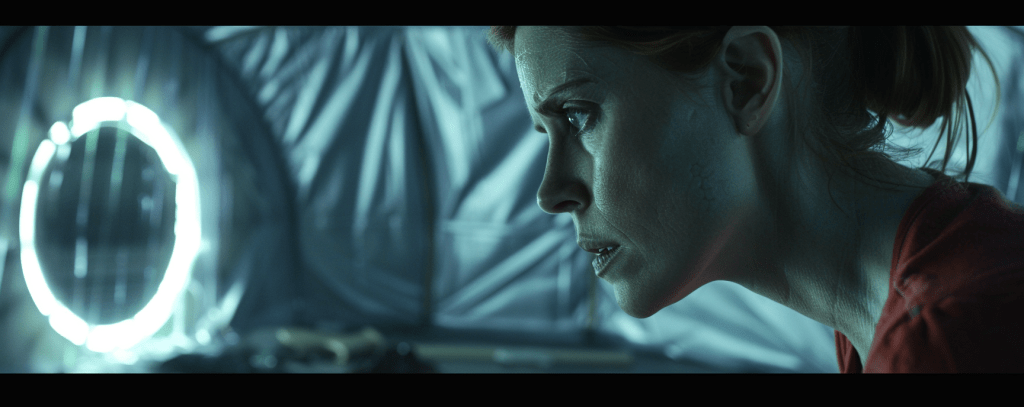
One of the pivotal uses of non-linear storytelling in “Arrival” is the manner in which it slowly unveils the unique nature of the Heptapod language, which is circular and non-linear itself. Unlike human languages, which are predominantly linear—progressing from one word or sentence to the next—the Heptapod language is written in complex circular symbols, encapsulating entire sentences or thoughts in a single moment without a beginning or end. This linguistic structure suggests a perception of time that is simultaneous rather than sequential. The film ingeniously mirrors this linguistic structure in its narrative form; scenes are presented in a way that blurs the line between past, present, and future, reflecting the circular, non-linear nature of the Heptapod language.
Analyzing specific scenes helps to illustrate how this technique enhances the narrative. Early in the film, Louise experiences what the audience presumes are flashbacks of her daughter. These scenes are interspersed with her efforts to communicate with the Heptapods, creating a narrative rhythm that parallels the emotional and cognitive dissonance Louise faces. As she becomes more proficient in the Heptapod language, her perception of time begins to mirror theirs. This shift is dramatically revealed in the film’s climax, where it becomes apparent that her visions of her daughter are not memories but premonitions. This realization recontextualizes every supposedly past-oriented scene encountered earlier in the film, inviting viewers to rethink the linear progression of time as experienced through the traditional cinematic narrative.
This non-linear arrangement not only serves the plot’s mysterious build-up but also deepens the viewer’s emotional engagement. By presenting “memories” that are actually glimpses of the future, “Arrival” aligns the audience’s discovery process with Louise’s. Each segment of what will happen in Louise’s life adds layers of meaning to her decisions and interactions in the present timeline of the alien arrival. This technique effectively places viewers within the same space of learning and revelation as Louise, fostering a profound connection to her character and her evolving perception of her existence and choices.
Thematic Depth Through Time Perception
“Arrival” masterfully explores profound themes such as the nature of time, the intricacies of communication across different mediums, and the philosophical contemplation of predestination. These themes are intricately woven into the fabric of the film through its non-linear narrative structure, which does more than simply tell a story—it invites the audience into a deeper understanding of these complex concepts.
Time and Its Perception
Central to “Arrival” is the theme of time, not merely as a sequential series of events but as a fluid, non-linear dimension that can be experienced simultaneously. This concept is a radical departure from the typical human understanding of time as linear and unidirectional. The film introduces this through the Heptapods, whose language embodies a completely different perception of time. For the Heptapods, time is non-linear; past, present, and future are viewed all at once, which is reflected in their circular language that has no beginning or end.
As Louise becomes more adept at the Heptapod language, her own perception of time begins to shift. This transformation is visually and narratively paralleled in the film through the interspersion of what the audience initially believes to be flashbacks with current events. These sequences progressively reveal that Louise is not remembering the future but perceiving it. This revelation not only challenges her understanding of her life and choices but also invites the audience to question the linear progression of their own lives. The film uses this thematic exploration of time to delve into questions of existence and the human condition, essentially asking if one could see their whole life laid out in front of them, would they choose to change it?
Communication Beyond Words
Another significant theme in “Arrival” is communication, which transcends the mere linguistic efforts to converse with the alien visitors. The film posits communication as a foundational element of human reality, necessary for genuine understanding and interaction. The Heptapods’ language, with its complex circular symbols, requires understanding beyond linear syntactic strings, involving an immersive engagement with time itself. This linguistic structure represents a holistic approach to communication, suggesting that understanding comes not just from linear exchange but from an integrated perception of information.
Louise’s journey in learning this language symbolizes the broader human quest for understanding and connection—not just across languages or species but across different perceptions of reality. The film cleverly juxtaposes her growing comprehension of the Heptapod language with her interpersonal communications, notably with her daughter and her colleague Ian. As Louise’s understanding of Heptapod deepens, so does her connection with her future daughter and Ian, highlighting that true communication involves deep empathy and the sharing of experiences and time.
Predestination and Choice
Interlinked with the themes of time and communication is the concept of predestination. “Arrival” poses a complex interplay between fate and choice, explored through Louise’s foreknowledge of her future. Once Louise understands the Heptapod language, she begins to see her future, particularly the life and loss of her daughter. This knowledge presents her with a profound moral and existential dilemma—knowing the future pain and loss that will come, does she choose the same path?
The non-linear narrative structure of the film accentuates this theme by presenting Louise’s future and past simultaneously, blurring the lines between what has happened and what is yet to come. This narrative choice reflects the film’s philosophical inquiry into whether our lives are predetermined or if we have the freedom to shape them. By the film’s end, Louise’s decision to embrace her future, despite knowing the coming heartache, suggests a complex acceptance of life as a tapestry of joy and pain, where choice and destiny are intertwined.
The film’s exploration of these themes through its non-linear narrative not only serves to engage the audience intellectually but also emotionally. It challenges viewers to reflect on their own perceptions of time, their ways of communicating, and their beliefs about fate and free will. By weaving these themes so deeply into its narrative structure, “Arrival” does more than entertain; it offers a profound commentary on the human experience. Through its sophisticated narrative techniques and thematic depth, the film stands out as a poignant study of the complexities of human existence, framed within the mesmerizing context of an alien arrival.
Emotional Impact and Viewer Engagement
The narrative structure of “Arrival” significantly enhances its emotional impact and deepens viewer engagement through its innovative use of a non-linear timeline. This approach not only serves the thematic depth of the film but also profoundly affects how audiences connect with the characters and the story, making the emotional journey both unique and compelling.
Emotional Resonance through Narrative Complexity
The emotional impact of “Arrival” is intricately tied to its non-linear storytelling, which allows for a nuanced build-up of character development and thematic exploration. By interweaving what appear to be flashbacks within the main narrative arc, the film creates an initial emotional distance between the viewers and the story of Louise’s daughter. These segments, which are gradually revealed to be flashforwards, shift the audience’s emotional engagement from one of retrospective sentimentality to anticipatory grief and existential pondering. This technique cleverly aligns the viewer’s emotional discovery process with Louise’s experiential learning of the Heptapod language, thereby enhancing empathy and understanding towards her character.
As Louise deciphers the alien script, she begins to perceive and experience her future, particularly the life and eventual loss of her daughter. The narrative structure allows the audience to experience Louise’s foreknowledge unfold in real time, which inverts the typical emotional experience of a narrative. Instead of foreseeing potential outcomes and hoping for characters’ happiness, the audience is placed in a position of inevitability, experiencing the poignancy of upcoming events that cannot be altered. This reversal of narrative expectation deepens the emotional gravity of each scene, making the film’s emotional texture richer and more complex.
The Climactic Reveal: Time, Memory, and Choice
The climax of “Arrival,” where it becomes clear that Louise’s experiences of her daughter’s life are not memories but premonitions, serves as a pivotal moment for emotional and narrative catharsis. This reveal not only redefines everything that has preceded it but also reframes the viewer’s understanding of the story’s structure and the characters’ destinies. The emotional weight of this revelation is immense, as it underscores the film’s meditation on fate, loss, and the bittersweet nature of human existence.
This knowledge impacts how viewers perceive Louise’s decisions, particularly her choice to embrace a future she knows will bring personal tragedy. It challenges audiences to consider what choices they would make if they had the same ability to see the future. Would they avoid pain at the cost of missing out on profound, albeit transient, moments of joy and love? This question invites viewers into a deeper emotional engagement, not just with the film but with its underlying existential themes.
Effectiveness of Non-Linear Storytelling
Non-linear storytelling in “Arrival” proves exceptionally effective in creating a memorable viewing experience that resonates emotionally and intellectually with audiences. This narrative style complements the film’s themes of communication and time, allowing for a storytelling experience that is as complex as the language Louise learns. By presenting time as non-linear and fluid, the film invites viewers to reconsider their linear perceptions of time and the consequential nature of storytelling.
Moreover, this method enhances the suspense and mystery of the plot, maintaining high levels of viewer engagement throughout. As the story unfolds, audiences are compelled to piece together the timeline, actively engaging with the narrative rather than passively consuming it. This active engagement is crucial in forming a deeper emotional connection with the film, as it mirrors Louise’s active struggle to understand and come to terms with her future.
The effectiveness of this storytelling approach is also evident in how it leaves a lasting impact on viewers. Films that challenge viewers to rethink narrative norms and engage deeply with the story often remain in audiences’ minds far longer than more straightforward narratives. “Arrival” achieves this by not only telling a compelling story but also by using its form to reinforce its themes—effectively ensuring that the experience of the film lingers in the minds and emotions of its viewers.
In conclusion, the non-linear narrative of “Arrival” is central to its success as a film that is both emotionally engaging and intellectually stimulating. Through its sophisticated use of time and memory, the film offers a unique cinematic experience that challenges conventional narrative structures and provides profound insights into human life and choices. It stands as a testament to the power of non-linear storytelling in enhancing the emotional depth and impact of a film, making “Arrival” not just a story about alien contact, but a poignant exploration of the human condition.
✍️ Whether you’re mastering the art of dialogue, structure, or character development, the power of AI can be a game-changer in your writing journey. My Free Ebook, ‘AI for Authors’ delves into how AI-powered prompts can provide a unique edge to your storytelling process. If you’re intrigued by the prospect of supercharging your fiction skills, download your free copy today and explore new horizons in creative writing.
 A.I. in Screen Trade