Introduction to Jake LaMotta: The Man Behind the Myth
In the pantheon of cinematic sports figures, Jake LaMotta, as portrayed in Martin Scorsese’s 1980 masterpiece, “Raging Bull,” occupies a unique and complex niche. Based on the real-life story of the middleweight boxer Jake LaMotta, the film offers a raw and unfiltered look into the life of an athlete whose legacy within the ring is as tumultuous as his life outside of it. Unlike typical sports narratives that often celebrate the triumphant rise of their protagonists, “Raging Bull” delves into the darker, more nuanced aspects of LaMotta’s character, presenting a multifaceted view of a man battling with his own nature, society’s expectations, and the consequences of his actions.
Born in 1922 on the Lower East Side of Manhattan to Italian immigrants, the real Jake LaMotta’s life was marked by hardship from an early age. His upbringing in a poor neighborhood, characterized by its toughness and propensity for violence, shaped LaMotta into a fighter both literally and metaphorically. These early experiences, defined by struggles with poverty, anger, and a relentless drive to prove himself, laid the foundation for a career that would be as celebrated as it was controversial. LaMotta’s prowess in the boxing ring earned him the nickname “The Bronx Bull,” a moniker that symbolized his aggressive fighting style and indomitable spirit. However, it was this very aggression that, while serving him well in combat, also became a source of turmoil in his personal life.
“Raging Bull” opens with an aging LaMotta, portrayed with haunting intensity by Robert De Niro, reciting a monologue from the stage. This opening scene sets the tone for the film, indicating that the story to unfold is not just about boxing but about the man himself. The film then takes us through key moments in LaMotta’s life, starting from his early days as a promising young fighter, through the peak of his career, and into his eventual decline, both professionally and personally. It is through these vignettes that the film crafts a deeply human portrait of LaMotta, eschewing a linear narrative for a more thematic exploration of his life.
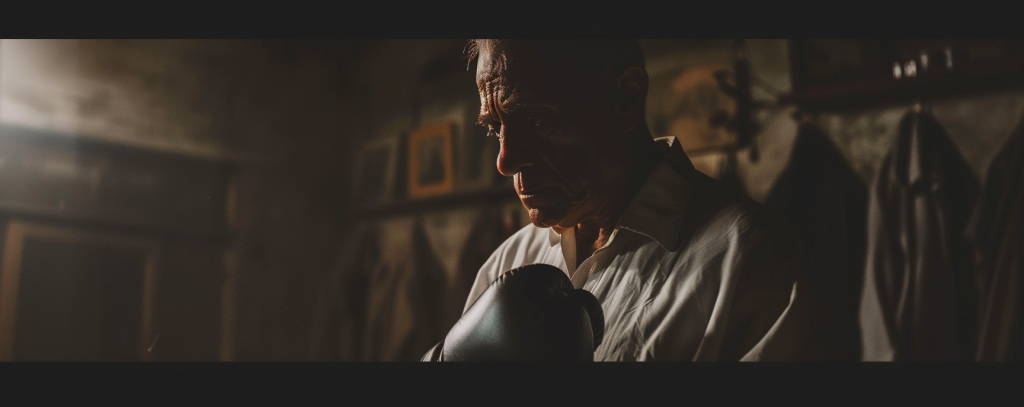
Central to “Raging Bull” and to understanding Jake LaMotta is the duality of his character. In the ring, LaMotta was unstoppable, known for his ability to endure and dish out punishment in equal measure. His bouts were not merely fights; they were spectacles of human will, with LaMotta often standing as the last man when others would have fallen. This resilience made him a champion, earning him the middleweight title in a legendary fight against Marcel Cerdan in 1949. Yet, the same ferocity that made him a champion also made him a volatile and often destructive force outside the ring. His life was fraught with episodes of violence, both in his personal relationships and in run-ins with the law, revealing a man struggling to contain the same rage that made him a star in the boxing world.
The complexity of LaMotta’s character is further highlighted by his relationships with the people closest to him. His brother Joey, played by Joe Pesci, serves both as his manager and as a foil to Jake’s volatile nature. Joey’s attempts to steer Jake away from self-destructive behaviors often fall on deaf ears, highlighting the depth of LaMotta’s inner turmoil. Similarly, LaMotta’s relationship with his wife Vickie, portrayed by Cathy Moriarty, oscillates between passionate love and destructive jealousy, offering a glimpse into the boxer’s troubled psyche. These relationships are not mere backdrops to the sports narrative but are integral to understanding LaMotta’s character. They reflect the inherent contradiction of a man who can exhibit great tenderness and brutal violence in equal measure.
“Raging Bull” does not shy away from depicting the uglier aspects of LaMotta’s life, including his bouts of domestic violence, his infidelities, and the deep-seated insecurities that drive much of his behavior. The film’s black and white cinematography, a choice made by Scorsese to evoke the feel of classic film noir, serves to underscore the starkness and brutality of LaMotta’s life, both inside and outside the ring. This aesthetic choice, coupled with the film’s attention to historical detail and its immersive portrayal of mid-20th century America, creates a rich tapestry against which LaMotta’s life unfolds.
Perhaps most striking about “Raging Bull” and its portrayal of Jake LaMotta is the film’s refusal to offer simple answers or redemption narratives. Unlike many sports films that culminate in a triumphant victory or moral resolution, “Raging Bull” presents a more ambiguous conclusion to LaMotta’s story. The film ends with a middle-aged LaMotta, overweight and long retired from boxing, reflecting on his life and career. This final image of LaMotta, alone with his thoughts and the ghosts of his past, invites the audience to ponder the cost of his rage, the price of his pride, and the elusive nature of redemption. In doing so, “Raging Bull” transcends the sports genre to offer a poignant study of a man who could conquer his opponents in the ring but struggled to master his own demons.
The Battle Within: LaMotta’s Inner Demons and Relationships
In Martin Scorsese’s “Raging Bull,” Jake LaMotta is portrayed as a man constantly at war, not just with his opponents in the ring but also with his own inner demons and the people closest to him. This section delves into the psychological battles LaMotta faces, his relationships that both define and are scarred by these battles, and how his personal story reflects broader themes of masculinity and vulnerability.
LaMotta’s struggle with jealousy, insecurity, and rage forms the backbone of his character’s complexity. These traits are not isolated; they are deeply interwoven into his identity, both as a man and as a boxer. The film masterfully portrays LaMotta’s jealousy as not merely a personal flaw but as a manifestation of deeper insecurities and a pervasive sense of inadequacy. His rage, though it fuels his success in the boxing world, also becomes his Achilles’ heel, leading to violent outbursts and a persistent dissatisfaction with life. LaMotta’s inability to control or understand these aspects of himself leads to a life marked by turmoil and self-destruction.
The dynamics of LaMotta’s relationships with his brother Joey and wife Vickie provide a lens through which to view his internal struggles. Joey, who acts as Jake’s manager and confidant, often finds himself trying to mitigate the consequences of Jake’s actions. Their relationship is characterized by a mix of deep familial love and conflict, with Joey’s efforts to protect his brother from his worst impulses only sometimes successful. The tension between the brothers is palpable, with Joey serving as a stark reminder of what Jake could have been had he not been consumed by his demons. This relationship intricately showcases the struggle between loyalty and frustration, love and disappointment, that defines much of Jake’s interactions with those around him.
Vickie LaMotta, Jake’s wife, becomes another focal point of his tumultuous emotional landscape. Their relationship is marred by Jake’s intense jealousy and insecurity, with scenes of domestic violence casting a long shadow over their marriage. Vickie, portrayed as both a victim of Jake’s rage and a symbol of his desire for control, mirrors his inner conflict between the need for love and the impulse towards violence. The film does not shy away from depicting the dark, destructive side of their relationship, highlighting how LaMotta’s personal insecurities manifest in his treatment of Vickie. Through this, “Raging Bull” offers a nuanced exploration of how toxic masculinity and vulnerability intertwine, leading to cycles of abuse and regret.
LaMotta’s self-destructive behavior, both in and out of the ring, acts as a physical manifestation of his internal battles. His penchant for punishment, his willingness to absorb tremendous amounts of pain, and his relentless aggression are not just strategies for winning fights; they are symptomatic of a deeper self-loathing and an inability to express vulnerability in any form other than violence. The film suggests that LaMotta’s masochism and rage are not merely personal failings but are also reflective of societal expectations of masculinity. In this way, LaMotta’s life story serves as a critique of the ways in which men are conditioned to equate toughness with invulnerability, and vulnerability with weakness.
Redemption and Downfall: The Path to Self-Realization
The narrative arc of Jake LaMotta in “Raging Bull” is a compelling study of the human capacity for both greatness and self-destruction. As the film unfolds, the latter years of LaMotta’s career and his life post-boxing emerge as a period marked by a significant shift in character and circumstance. This final chapter in LaMotta’s story is as much about his struggles outside the ring as it is about his attempts at redemption and self-realization.
Following his retirement, LaMotta’s life takes a divergent path from the glory and adrenaline of his boxing days. His departure from boxing is not followed by a peaceful transition into a life of contentment but rather leads to a series of personal and professional misadventures. LaMotta ventures into nightclub ownership, stand-up comedy, and even a stint in prison for introducing minors to a nightclub. These endeavors highlight a man grappling with his identity in the absence of the violence that once defined him. The consequences of his earlier actions—his temper, domestic abuse, and the relentless pursuit of pride—culminate in a series of failed relationships, alienation from his family, and a tarnished reputation.
Amid these trials, LaMotta’s journey towards self-realization and peace becomes a central theme. The film masterfully portrays LaMotta’s internal battles as he confronts the repercussions of his past behaviors. His search for redemption is depicted not as a quest for external validation but as an inward journey marked by introspection and the struggle to understand and forgive himself. LaMotta’s interactions with his brother Joey, his ex-wife Vickie, and his children are imbued with a sense of regret and a desire for atonement. However, the film leaves open the question of whether LaMotta truly finds the redemption he seeks. It portrays a man who has come to recognize the faults in his character and actions, yet it is ambiguous about whether this recognition leads to genuine change or understanding.
The portrayal of LaMotta’s quest for redemption is further complicated by the film’s depiction of his legacy. “Raging Bull” does not offer a neat resolution to LaMotta’s story; instead, it presents a nuanced view of redemption, one that is inherently personal and fraught with complexity. The film suggests that redemption is not a single act or a moment of epiphany but a continuous process that involves confronting one’s demons, making amends, and striving to be better. LaMotta’s legacy, as depicted in the film, is thus a reflection of the human condition—flawed, contradictory, and perpetually in search of meaning.
The film concludes with an older LaMotta, shadowboxing in the dressing room of a nightclub where he is about to perform a stand-up routine. This scene serves as a powerful metaphor for LaMotta’s life—the fight continues, but now it is against the shadows of his past, in a ring where the stakes are personal redemption and self-understanding. The final shot, a biblical quote from the Gospel of John, underscores the theme of redemption and the possibility of finding light in the darkness of one’s own making.
“Raging Bull” thus leaves its audience with a profound meditation on the nature of redemption and the complexities of the human spirit. It challenges conventional narratives of downfall and redemption by presenting a character whose path to self-realization is as tumultuous and uncertain as his life. In doing so, the film offers a deeply human portrayal of Jake LaMotta, a man whose legacy is defined not just by his victories and defeats in the boxing ring but by his enduring battle with himself.
✍️ Whether you’re mastering the art of dialogue, structure, or character development, the power of AI can be a game-changer in your writing journey. My Free Ebook, ‘AI for Authors’ delves into how AI-powered prompts can provide a unique edge to your storytelling process. If you’re intrigued by the prospect of supercharging your fiction skills, download your free copy today and explore new horizons in creative writing.
 A.I. in Screen Trade