The Artistry Behind Austen’s Timeless Novels
Jane Austen, born in 1775 in the quiet village of Steventon, Hampshire, remains one of the most renowned authors in English literary history. Her tales, set predominantly against the backdrop of rural England, have charmed readers for generations. Austen, however, wasn’t just a teller of romantic tales. Her astute observations on society, manners, and relationships offer a profound understanding of human nature. So, what makes her works stand out? And how does her prose connect with today’s creative writing endeavors?
To begin with, it’s crucial to recognize Austen’s refined narrative style. Her prose, peppered with wit and irony, stands as an epitome of literary elegance. A unique blend of free indirect discourse and detailed characterization made her novels groundbreaking during her time. This technique allowed readers to gain intimate insights into the consciousness of her characters. For instance, in Pride and Prejudice, Austen artfully employs this method to lay bare the prejudices of her protagonist, Elizabeth Bennet, as well as the societal pressures that shaped her judgments. Such intimate character studies offer invaluable writing tips for budding authors looking to add depth to their narratives.
Another feature that distinguishes Austen’s prose is her balance between detailed exposition and dialogue. Her novels are conversationally rich, which brings the characters to life, anchoring the plots in their interactions. The conversations in her novels aren’t merely for forwarding the narrative; they act as windows into the deeper layers of her characters’ personalities, their values, and the world they inhabit. This exquisite interplay of dialogue and exposition is a technique worth emulating for anyone venturing into writing a novel.
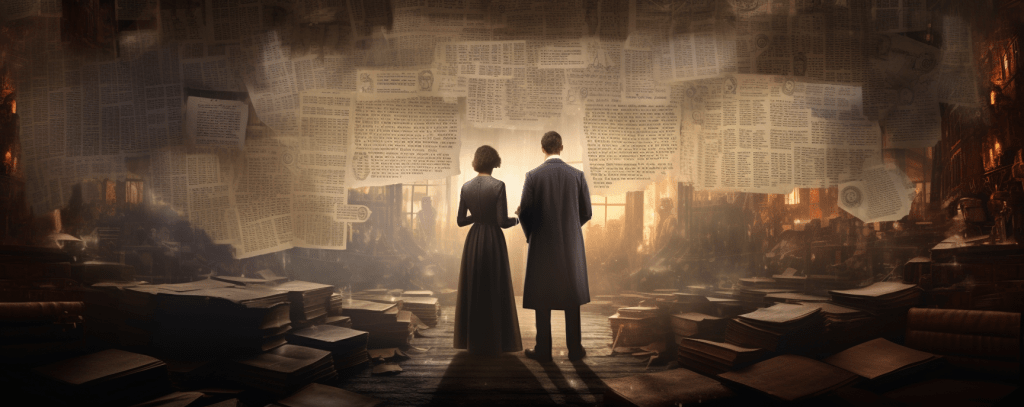
Furthermore, Austen’s creative choices in structuring her narratives are exemplary. She often employs a central protagonist, usually a strong-willed woman, around whom the tale unfolds. This ‘central consciousness’ approach provides the readers with a consistent perspective, making the narrative both intimate and relatable. It’s a technique that resonates particularly with the tenets of modern creative writing. By consistently maintaining a focal perspective, writers can foster a deeper connection between their readers and the story.
While some critics argue that Austen’s themes primarily revolve around the domestic, a closer look reveals a rich tapestry of socio-political commentary. Issues of class, gender roles, and economic disparity feature prominently in her works. Austen’s novel, Mansfield Park, for instance, delves into the moral complexities of British colonialism, albeit subtly. By weaving these commentaries into engaging tales of romance and personal growth, Austen showcases the power of literature to mirror and critique society. Such integration of broader themes into a focused narrative can serve as an inspiration for those looking to enhance their creative writing pursuits.
No discussion of Austen’s artistry can be complete without touching upon her unparalleled wit. Her razor-sharp irony shines in her character portrayals and narrative voice. For example, the opening line of Pride and Prejudice – “It is a truth universally acknowledged, that a single man in possession of a good fortune, must be in want of a wife” – exemplifies this. Such clever use of language not only captivates readers but also instructs writers on the nuances of sarcasm and wit in prose.
Jane Austen’s relevance in the contemporary literary landscape isn’t merely a testament to the timeless appeal of her stories. It’s equally about the sophistication of her narrative techniques and her mastery over the English language. To a budding writer, Austen’s novels are more than just compelling reads; they’re a treasure trove of writing tips waiting to be unearthed. Delving into her works can offer insights into character development, dialogue crafting, and the subtle art of irony, all essential tools for anyone aiming to improve writing skills.
Jane Austen’s Influence on Modern Literature
The profound mark that Jane Austen left on the literary world is undeniable. While the specifics of balls, curtsies, and mannered courtships may seem distant to the modern reader, the core themes, character dynamics, and social critiques remain as poignant as ever. This, perhaps, explains why her narratives resonate so deeply with contemporary authors and readers alike. However, Austen’s influence isn’t just evident in the countless adaptations of her stories; her narrative techniques and unique voice have shaped the bedrock of modern literature in more ways than one might imagine.
Arguably, one of the most significant contributions of Austen to the contemporary literary landscape is the complex, multi-dimensional female protagonist. Before Austen, female characters often existed within limited archetypes in literature. However, with characters like Elizabeth Bennet, Emma Woodhouse, and Anne Elliot, Austen painted a more nuanced picture of womanhood. Today, in the diverse and expansive universe of modern fiction, protagonists, especially female ones, are portrayed with a depth and authenticity that echo Austen’s pioneering character sketches. Writers, consciously or subconsciously, draw from her technique, ensuring that their characters are not just one-dimensional but are products of their circumstances, experiences, and choices.
Furthermore, Austen’s intricate explorations of societal norms, especially those related to class and marriage, paved the way for literature that reflects and critiques society. Consider, for instance, novels like The Great Gatsby by F. Scott Fitzgerald or The Age of Innocence by Edith Wharton. Both these works, though set in a different era and culture, delve deep into the social intricacies of their time. They dissect the norms, much like Austen did, presenting a narrative that’s both a reflection and a critique of society. It’s a testament to Austen’s influence that even after centuries, writers continue to use literature as a lens to scrutinize the social constructs of their epochs.
From a structural standpoint, Austen’s novels exemplify a balance that many contemporary authors aspire to achieve. The pacing in her works, the seamless interplay between dialogue and narrative, and the crescendos leading to character revelations are masterclasses in storytelling. For writers aiming to improve writing skills, analyzing the structure of an Austen novel can provide invaluable insights. Consider the slow, simmering tension between Elizabeth Bennet and Mr. Darcy in Pride and Prejudice. The nuanced evolution of their relationship, replete with misunderstandings, realizations, and ultimate acceptance, offers a lesson in pacing and character development. Such techniques have become foundational for anyone venturing into the domain of writing a novel in today’s world.
Another hallmark of Austen’s influence is the rise in the popularity of domestic novels. While she wasn’t the sole pioneer of this genre, her emphasis on the everyday, the familial, and the internal world of her characters played a significant role in its establishment. Contemporary literature, with its widespread focus on personal journeys, familial dynamics, and intimate evolutions, owes a lot to the path paved by Austen. Think of celebrated works like To Kill a Mockingbird by Harper Lee or Little Fires Everywhere by Celeste Ng. Both these novels, in different ways, capture the essence of human relationships and societal reflections within the confines of a seemingly ‘ordinary’ setting, much like Austen’s rural English backdrop.
Yet, it would be a misstep to assume that Austen’s influence is solely confined to novels that explore societal norms or are set in domestic environments. Even genres like fantasy, science fiction, or thrillers, which might seem far removed from the drawing rooms of Regency-era England, can trace some elements of character dynamics or societal critique back to Austen’s influence. Her emphasis on character-driven narratives, as opposed to mere plot-driven tales, has permeated nearly all genres of modern literature.
Channeling Austen: Using Her Work as a Tool for Writers
Literature, like any art form, has an ebb and flow, influenced by its antecedents. Jane Austen’s oeuvre not only holds intrinsic value as a testament to her genius but also serves as a guidepost for those treading the path of literary creation. Whether you’re a seasoned writer or someone just beginning their journey, Austen’s works offer invaluable tools. Let’s delve into how her prose can be transformed into a writer’s arsenal, encompassing everything from writing prompts to deeper narrative exploration.
First and foremost, character development. Austen’s characters are a masterclass in depth and nuance. Taking a leaf from her book (quite literally) can enable writers to craft multi-dimensional characters. For instance, charting the transformation of Emma Woodhouse from a self-assured, slightly condescending young woman to someone who gains self-awareness can serve as a guide. Writers can dissect her character to understand how external events and internal realizations converge to drive character growth. Analyzing the likes of Mr. Knightley, and understanding his role as a mirror to Emma’s flaws, can also assist writers in designing secondary characters that push protagonists towards evolution. This is an essential exercise for those keen to improve writing skills in the realm of character crafting.
But Austen’s novels aren’t just about the people; they’re about the world these people inhabit. Her depiction of Regency-era England, with its intricate societal norms and unspoken codes of conduct, is meticulous. For writers, this offers a lesson in world-building. One doesn’t need to be writing an epic fantasy to understand the importance of a well-constructed setting. Every story has its own world, whether it’s a small town in 19th-century England or a sprawling metropolis in the 21st. Examining how Austen places her characters within the larger societal fabric, and how she uses settings — from ballrooms to parsonages — to forward her narrative, can be instrumental.
For those battling the notorious writer’s block or seeking a fresh perspective, Austen’s works can be a source of inspiring writing prompts. Imagine modernizing a classic Austen dilemma: How would the misunderstandings between Elizabeth and Darcy play out in the age of social media? Or consider a role reversal — what if Fanny Price from Mansfield Park was born with privilege and wealth, while Mary Crawford faced a life of humility? These prompts, rooted in Austen’s narratives but twisted with fresh perspectives, can ignite creativity. Websites like Reedsy regularly curate such prompts, drawing from classics to spur modern tales.
Another aspect where Austen’s works shine is conflict resolution. The climax of her novels isn’t marked by grand events but by personal realizations. Emma’s recognition of her feelings for Mr. Knightley, or Elizabeth Bennet’s acknowledgment of her prejudice, serves as the pinnacle of the narrative. This is an essential lesson for writers — conflicts don’t always need external cataclysms for resolution; sometimes, the most profound battles are fought within. Writers can dissect Austen’s climaxes to understand how character arcs and narrative tensions converge, offering a satisfying conclusion. This is a key aspect of writing a novel that feels both true to its characters and satisfying to its readers.
Lastly, Austen’s dialogues are a treasure trove for writers keen to hone their skills in crafting conversations. The banter between her characters, the unsaid emotions, the wit, the sarcasm, and the underlying tensions are all conveyed through dialogues that seem effortless. By studying her dialogues, writers can grasp the subtleties of crafting conversations that are both revealing and engaging. Sites like The Write Practice often emphasize the importance of authentic dialogues, and Austen’s novels serve as a prime example in this domain.
In essence, Jane Austen’s novels are not just for readers but are a goldmine for writers. They encapsulate lessons in character development, world-building, conflict resolution, and dialogue crafting. For writers keen to channel the magic of Austen into their works, immersing in her novels isn’t just an exercise in reading, but an exploration of the craft itself. Her timeless narratives, while set in a bygone era, are replete with insights and techniques that are profoundly relevant to contemporary storytelling. And in this way, Austen’s legacy lives on, not just in the hearts of readers but in the pens (or keyboards) of countless writers she continues to inspire.
✍️ Whether you’re mastering the art of dialogue, structure, or character development, the power of AI can be a game-changer in your writing journey. My Free Ebook, ‘AI for Authors’ delves into how AI-powered prompts can provide a unique edge to your storytelling process. If you’re intrigued by the prospect of supercharging your fiction skills, download your free copy today and explore new horizons in creative writing.
 A.I. in Screen Trade